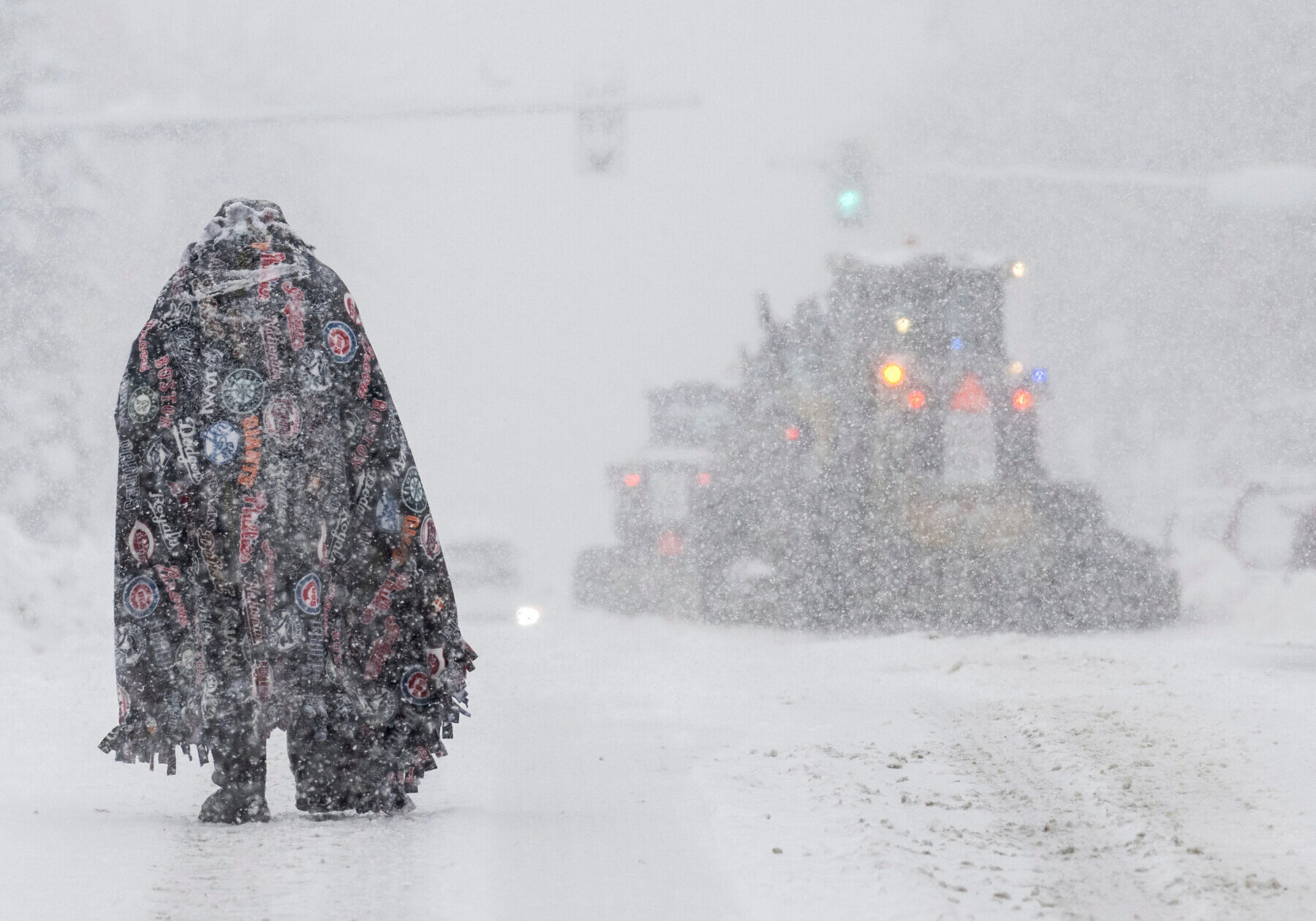

Alaska Native people are profoundly overrepresented among Alaska’s homeless population. Behind the statistics are people whose paths can lead from villages to Anchorage, from family to shelter, and sometimes thousands of miles from home.
There is a saying, “No matter how far away you get, or how long you’ve been gone, your village always knows where to find you.”
This could mean several things. It might mean that if you get lost from your village, in a hub-community, in Anchorage, or Seattle, or anywhere beyond that, your family, your village will eventually find you. Now, whether or not finding you is a good thing or a bad thing is another story. Or it means that no matter where you end up, there will be reminders of home, of your village.
This is my way of saying that this story, like so many stories an Indigenous journalist must report, is not something that happens to someone else. In too many ways, you are portraying the stories of your race, your people, your culture, your tribe, your village, your family, and – in this case – your mom.
For years too many to count, my Yup’ik birth mother experienced homelessness in Anchorage, Alaska. Hers was mostly intermittent, usually because she acted in a way that she was no longer welcome. How she became such a person is a much more tragic story deserving its own telling. For now, one of her myriad experiences in this world was one of homelessness. (Another experience was being featured in Vogue Magazine in the 60s, for proud contrast.)
In fact, one of the most embarrassing days of my life was the day I saw her panhandling on the street corners of Anchorage. The horror of my own birth mother holding one of those signs, hoping for handouts. It didn’t matter that no one knew she and I were related. It didn’t matter that no one saw me in my car at that stoplight, but I was mortally embarrassed.
Whether picking her up from someone who kicked her out, or responding to her call for a ride, or any other of the crazy scenarios, the result was mostly driving her to the Brother Francis Shelter.
You can imagine people, sometimes other family, saying, “How could you treat her like that? Why didn’t you help her?”
The sad truth was, I knew I was the last call.
I knew if she was calling me, then everyone else she tried to call either didn’t answer or told her “No.” I knew she couldn’t be in my tiny condominium. The only safe thing to do was take her to the shelter.
The happy ending to the story was that she finally did find permanent housing, once she finally quit drinking, a miracle I still don’t understand, in Portland, Oregon.
Not our village.
Not in Anchorage.
Not in Alaska.
But Portland, Oregon.
She died there. Over 2,000 miles from the villages her family had lived in for centuries.
She is not the only family member to experience homelessness in Anchorage.
Thus, if my journalism seems tough at times, don’t worry about forgiveness, but I do ask for understanding.
Because my mother’s story is personal.
The numbers are not.
An Extraordinary Disparity
American Indian and Alaska Native people accounted for 44.6 percent of Alaska’s population experiencing homelessness in the 2024 Point-in-Time count, according to the Alaska Department of Health. Alaska Native and American Indian people make up only 20% of Alaska’s overall population.
That disparity is not subtle. It is one of the defining facts of homelessness in Alaska.
And yet we know surprisingly little about what is behind it.
We know some of the usual answers.
Housing costs. Alcohol and drugs. Mental and physical illness. Domestic violence. Unemployment. Family breakdown. Incarceration. Rural-to-urban migration.
And history.
Always history.
Colonisation brought epidemics, economic disruption and displacement. Native children were removed from families through boarding-school systems designed partly to suppress Indigenous language and culture. Communities experienced profound changes in governance, religion, subsistence economies and family structures.
But knowing the history is not the same as knowing the people.
In Anchorage’s 2024 Point-in-Time survey, inability to pay rent or a mortgage was the most commonly reported contributor to homelessness. Eviction and inability to find work followed. Substance misuse was reported too, but the data do not support the convenient assumption that everyone sleeping outside is there because of alcohol or drugs.
My mother drank.
That does not mean everybody’s mother did.
That distinction is important.
People Come to Anchorage
Anchorage has always been something different for Alaska Native people.
It sits on the homeland of the Idlughe Ht’ana Dena’ina people, but modern Anchorage has also become something resembling the capital of an Alaska that has a unusual capital, Juneau.
People come here.
From Bethel. Nome. Kotzebue. Utqiaġvik. Dillingham. Unalakleet. Hooper Bay. Mountain Village. St. Mary’s. Emmonak. And hundreds of other communities.
They come for hospitals, jobs, school, court, treatment, shopping, family and opportunity.
Sometimes they stay.
Sometimes they get stuck.
Joseph Link came from Bethel looking for work.
By 2022, the Yup’ik man had been living in a tent in Anchorage for two years.
“My family taught me how to survive,” Link told Alaska’s News Source, “but, can’t do it here.”
There is something painfully Alaska Native about that sentence.
A person can know how to survive on the land and still not know how to survive homeless in a city.
But we should be careful.
We do not actually have good enough contemporary data to say that most Alaska Native people experiencing homelessness in Anchorage came from villages.
Some were born here.
Some have lived here for decades.
Some have nowhere else they consider home.
And some might be offended by the suggestion that the solution to their homelessness is to ship them “back to the village.”
That is where policy must stop making assumptions and start asking questions.
Where do you want to go?
Who is there?
Can you safely go back?
Do you even want to?
What would it take for you to have a home here?
Anchorage Is Trying Something Different
The Municipality is no longer relying exclusively on emergency shelters and hoping something happens afterward.
Its official strategy, Anchored Home 2023-2028, developed with the Anchorage Coalition to End Homelessness and community partners, seeks to make homelessness “rare, brief and one-time.”
That sounds like government language.
The practical meaning is simpler.
Keep people from becoming homeless when possible. Shelter them when prevention fails. Get them into housing. Give those who need it enough support to remain there.
Anchorage counted 402 people sleeping outdoors during its 2025 winter Point-in-Time count.
In 2026, it counted 291.
That is a 28 percent decline.
Large entrenched encampments that had become familiar features of Anchorage also disappeared.
Assembly Chair Christopher Constant drove around Anchorage checking the old sites himself.
“What I found was amazing,” he said. “The large, entrenched encampments are gone.”
Good.
Now comes the question Indigenous journalists — and everybody else — should ask.
Where did the people go?
Because tents are not homeless.
People are.
A Family Made Outside
Robbie Annogiyuk had experienced homelessness intermittently in Anchorage for nearly 20 years when the Municipality cleared the encampment where he was staying in November 2025.
He described something about homelessness that statistics have trouble measuring.
Family.
“You become attached to people,” Annogiyuk told Alaska Public Media. “We think of ourselves as a family, and we don’t leave anybody behind.”
Then he explained why.
“Because, I mean, that’s how people die, you know, when you leave ’em behind.”
I understand that better than I would like.
Families sometimes reach the end of what they can do.
That does not necessarily mean they stopped loving somebody.
I loved my mother.
I also drove her to Brother Francis Shelter. Because I loved her.
Everything can be true.
The homelessness system is increasingly beginning to recognize that complicated reality.
The Municipality recently directed another $1.3 million in federal money toward supportive housing — programs intended not simply to put somebody in an apartment, but to help that person remain there.
“Anchorage needs more services that help people not only find a home but stay in one,” Mayor Suzanne LaFrance said when announcing the funding.
That last part matters.
Native Problems Require Native Voices
Cook Inlet Tribal Council provides intensive case management addressing housing, employment and other needs for Alaska Native and American Indian people.
Brother Francis Shelter works with Alaska Native Tribal Health Consortium and Southcentral Foundation among its health-care partners.
The Anchorage Coalition to End Homelessness has also experimented with flexible assistance through its Good Neighbor Fund.
Sometimes the obstacle is identification.
Sometimes medicine.
Sometimes a hotel room.
And sometimes it is just an airplane ticket.
In one case, the fund spent roughly $400 to help a young woman who had recently arrived in Anchorage return to her family in a rural Alaska village.
That might have been exactly the right answer for her.
It would not necessarily have been the right answer for my mother.
Her permanent housing was eventually in Portland. Not my decision. Not most of the family’s decision. Hers. Somehow, that is where she found peace. And thank every god, and every spirit around the world, that she did find it somewhere.
That is the lesson policymakers should remember.
There is no single Alaska Native homelessness story.
There cannot be a single Alaska Native homelessness solution.
What We Still Don’t Know
For all the plans, programs, committees, coalitions, shelters, surveys and millions of dollars spent, Anchorage still cannot publicly answer some surprisingly basic questions.
How many Alaska Native people experiencing homelessness in Anchorage came here from rural communities?
How many grew up here?
Why did they become homeless?
How many became homeless after leaving jail, a hospital or treatment?
How many want to return to their villages?
How many cannot?
How many get apartments and remain in them five years later?
And what do homeless Alaska Native people themselves say would have prevented their homelessness?
Until we know those things, we should be careful about claiming we know the solution.
We do know something else.
Anchorage has made measurable progress. Fewer people were counted sleeping outdoors in 2026. Large encampments have been dismantled. Housing and supportive services are receiving greater attention. Government, nonprofits, Native organisations and the Anchorage Coalition to End Homelessness are increasingly working as pieces of a larger system.
But Alaska Native people remain extraordinarily overrepresented among Alaska’s homeless population. And extraordinarily underrepresented in the solutions.
That should bother us.
Not because every homeless Native person is somebody’s mother.
Because every homeless Native person is somebody.
My mother eventually found her home.
It wasn’t the home I would have predicted for her. It wasn’t where generations before her lived. It wasn’t Alaska.
But she had a door.
She had a key.
She had somewhere she could go where, regardless of what inspired her, she followed the rules, and could, therefore, stay as long as she wanted. And she was, thus, inspired.
My Yup’ik mother died sober. She died surrounded by friends and caretakers, people I hope she felt close to. But I will leave every journalistic pretense happily behind to be sure you know that my mother died sober. I say this not because I am proud of her, but because I love her. After her life, dying sober in a safe place is practically a miracle.
Maybe that is where we should begin measuring success.
Not by tents removed.
Not by camps cleared.
Not even by shelter beds filled.
Ask where the person went.
Ask whether they wanted to go there.
Ask whether they are still there a year later. Or ten.
And then, perhaps, remember that old saying.
No matter how far away you get, or how long you’ve been gone, your village always knows where to find you.
The question for Anchorage is: Does Anchorage know?
Sources
Alaska Department of Health — Homelessness Education and Resources
Statewide homelessness demographics, racial disparities, health and housing information.
https://health.alaska.gov/en/education/homelessness-health/
Anchorage Coalition to End Homelessness — Anchored Home 2023–2028
The five-year Anchorage homelessness strategy, with links to the plan and progress reporting.
https://www.aceh.org/anchored-home
Municipality of Anchorage — Housing and Homelessness / Municipal Action
For the Municipality’s implementation, funding and history of homelessness-response actions, this current Assembly timeline is particularly useful.
https://www.muni.org/Departments/Assembly/SiteAssets/Pages/FOCUS-Homelessness/Timeline%20of%20MOA%20and%20Assembly%20Action%20on%20Homelessness_through%202025.pdf
Alaska Public Media — May 26, 2026
The numbers are in: Fewer homeless people slept outdoors in Anchorage this winter — reports the 2026 Point-in-Time results, including the decline in unsheltered homelessness.
https://alaskapublic.org/news/anchorage/2026-05-26/the-numbers-are-in-fewer-homeless-people-slept-outdoors-in-anchorage-this-winter
Alaska Public Media — Nov. 25, 2025
A new Anchorage fund aims to remove small barriers to stability — contains the Robbie Annogiyuk interview and reporting on the Good Neighbor Fund.
https://alaskapublic.org/news/anchorage/2025-11-25/a-new-anchorage-fund-aims-to-remove-small-barriers-to-stability
Alaska’s News Source — Oct. 21, 2022
The many faces of Anchorage’s homeless population — contains the interview with Yup’ik man Joseph Link and reporting about Alaska Native overrepresentation in Anchorage homelessness.
https://www.alaskasnewssource.com/2022/10/21/many-faces-anchorages-homeless-population/
Cook Inlet Tribal Council — Financial Assistance / Intensive Case Management
Describes CITC’s housing, employment and homelessness-prevention assistance for Alaska Native and American Indian people living in Anchorage.
https://citci.org/assistance/
Catholic Social Services — Medical Care at Brother Francis Shelter
Describes the medical services available at Brother Francis Shelter, including the Caring Clinic staffed and supported by Southcentral Foundation.
https://www.cssalaska.org/our-programs/brother-francis-shelter/medical-care-brother-francis-shelter/