Alaska was built on salmon. Now, in parts of Western and Interior Alaska, the fish are disappearing—and salmon people are asking how much of themselves can disappear with them.
When I was 23 years old, I traveled out to my village for the first time.
I had met my birth mother and birth sisters the year before, but now I was flying to the actual place where I understood my Yup’ik ancestors had lived for thousands of years: Hooper Bay.
(OK. That ended up not being quite true. We’re actually from Paimiut, 15 miles north. But that is a different story.)
I climbed down the awkward steps of the de Havilland Twin Otter and there was a woman jumping up and down.
“You really are here! You’re home! We never forgot about you!”
It was my Aunt Agatha.
She put me on the back of a four-wheeler and off we went toward town. Waving here, stopping there. This is family. They are family. Those people over there are family, too.
It was slowly sinking in that there were all these people on Earth to whom I was related, and I had gone 23 years with absolutely no inkling they existed.
I somehow felt guilty for forgetting something I had never been allowed to know.
Eventually we arrived at my Papa’s house—my grandfather’s house—where maybe 30 relatives were waiting to meet me.
It was already overwhelming.
Then Agatha asked the question.
“Have you had dried fish and seal oil?”
“No.”
The room reacted with the collective gasp of an old-time movie. I could almost hear generations of family spirits whispering to one another: What have those barbaric White people been feeding this poor boy?
“Well, you have to try dried fish and seal oil.”
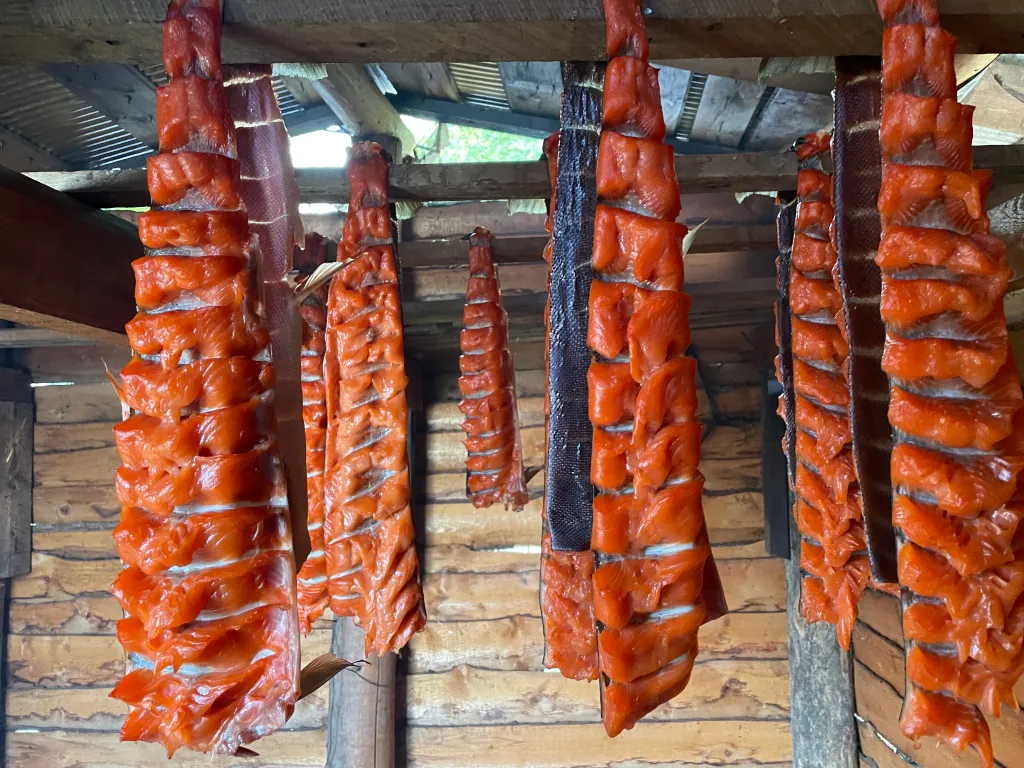
Agatha rustled around the kitchen, which sat in the corner of the big dining room, the center of the house. The dried fish was silver salmon—coho—lightly cold smoked and dried in the relentless coastal wind. The fillet had been cut in diagonal strips almost through to the skin, making chunks that could be torn loose by hand.
The seal oil was what it sounds like: oil rendered from seal fat.
Agatha demonstrated.
Tear off a chunk of salmon. Bite the end to fray the dried meat. Dip that fuzzy end into generously salted seal oil.
Eat.
Simple enough.
I did what I was told. Then, just as I raised the salmon toward my mouth, I made the mistake of looking up.
Thirty pairs of Yup’ik eyes were staring at me.
Not casually, either.
There was every indication that if I reacted badly, somebody still knew the flight schedule back to Bethel. Or a charter could be arranged if absolutely necessary.
I bit into the salmon.
The seal oil squished into my mouth.
It was a strange flavor and, at the same time, somehow not strange at all. First the oil. Then the salt. Then the salmon.
It felt like my ancestors were dancing in my mouth.
Always.
The part that confused me most was not where I was.
I knew where I was.
What baffled me is when I was.
I realized I had been waiting my entire life for that bite, and I had never known I was waiting.
“Mmm,” I said. “That’s good.”
Agatha shrieked what apparently everyone in the room had been waiting to hear.
“OH!!! HE REALLY IS YUP’IK!!!”
I tell this story because I am a journalist writing about a salmon crisis, but I am also a salmon person. And I am a salmon person whether I choose to be or not. Whether raised in Anchorage or Addis Ababa, by white people, or by devout Hindi vegetarians, I would be a salmon person. Always.
That is relevant information.
It does not excuse me from checking numbers, questioning claims, separating evidence from opinion or reporting disagreement among Alaska Native people. If anything, it makes those obligations more important. But journalistic integrity does not require pretending that the person holding the notebook has no history.
My history includes salmon.
Just like Alaska’s.
There are five Pacific salmon species commonly harvested in Alaska—Chinook, chum, coho, pink and sockeye—and they have fed people here for thousands of years. Salmon also helped shape the political creation of modern Alaska. By the late territorial period, collapsing runs, federal fisheries management and enormous fish traps associated largely with outside interests had become powerful symbols in the statehood movement. The new State of Alaska immediately outlawed the traps and assumed management of its fisheries.
That history makes the current crisis disturbingly familiar.
Once again, Alaska is arguing over who gets salmon, who manages salmon, who sacrifices salmon and whose knowledge counts when there are not enough salmon.
Except now, in some Native villages, the question is becoming more frightening:
What happens when the salmon stop coming home?
First, understand that Alaska is not running out of salmon
This would be much easier to explain if salmon were simply disappearing everywhere.
They are not.
In 2021 and 2022, Western Alaska Chinook and chum abundance fell to extraordinary lows, while sockeye abundance reached record highs. That difference is scientifically important because it immediately argues against any explanation that treats “Alaska salmon” as one population responding uniformly to one cause.
The center of the crisis is the Arctic-Yukon-Kuskokwim region, especially the Yukon River.
Yukon Chinook had already been declining for decades before the recent crash. The 2022 adult return was roughly 81 percent below the 1991–2020 average. Yukon chum reached a record low in 2021, approximately 92 percent below its 30-year average. Chinook declines have also struck the Kuskokwim, Unalakleet and Nushagak systems.
And this is not history.
It is happening while this article is being written.
As of early August 2026, Alaska managers said the Canadian-origin Yukon Chinook run would again fail the required 71,000-fish border rebuilding target. Chinook passage remained well below average, and all Chinook caught in Alaska’s Yukon fisheries were required to be released alive.
On the Kuskokwim, managers closed coho subsistence fishing from the river mouth through Aniak on August 7. About 43,000 coho had passed the sonar by August 5. Normally, approximately 106,500 have passed by then.
That is what a salmon crisis looks like in government language.
Numbers. Goals. Sonar. Escapement. Emergency orders.
But there is another way to describe it.
Nick Andrew Jr., Tribal president of the Native Village of Marshall, put it this way in a 2023 interview:
“Salmon does define who I am. It does define my ancestors, my family, my relatives, everyone on the river.”
So where are the salmon going?
For years, almost everybody had a suspect.
Climate change.
Warm rivers.
The Bering Sea.
Commercial fishing.
Pollock trawlers.
Bycatch.
Area M.
Hatcheries.
Disease.
Predators.
Habitat.
Canada.
Depending upon whom you asked, somebody somewhere was killing the salmon.
The best science now gives us a better answer, although not a complete one.
In July 2026, NOAA Fisheries reported the results of a life-cycle analysis of Yukon Chinook that incorporated juvenile abundance, adult returns, harvest and bycatch. The study found that the recent catastrophic decline was strongly associated with a sharp increase in natural mortality after the juvenile stage, beginning around 2016 and coinciding with prolonged marine heatwaves in the Bering Sea.
In plain English: Large numbers of young salmon were making it to sea, but too many were not surviving long enough to come back.
That fits other evidence. Marine heatwaves altered the Bering Sea food web. Capelin—an important forage fish—declined sharply. Separate research on Western Alaska chum has shown that young salmon exposed to unusually warm conditions could grow while carrying poorer energy reserves, apparently because the quality and availability of their food changed.
The fish themselves have changed, too.
Yukon Chinook are smaller than they once were. NOAA’s synthesis found average adult length has declined roughly 5 to 7 percent since the 1970s, with researchers estimating substantial corresponding losses in fecundity and egg mass. A river containing 50,000 smaller, younger females is not necessarily reproductively equivalent to a river containing 50,000 of the great old Chinook people remember.
None of this means every scientific question has been answered.
Freshwater warming matters. Disease remains under study. Predation matters. Habitat matters. Hatchery competition is a legitimate research question. Mixed-stock commercial fisheries remove some Western Alaska salmon.
But the strongest evidence currently points to a changing marine ecosystem—and particularly increased natural mortality at sea of salmon long before they become the salmon we catch—as a major driver of the recent Yukon Chinook disaster.
That brings us to perhaps the most bitter word in this entire story.
Bycatch.
“Every salmon counts”
The Bering Sea pollock fishery sometimes catches salmon while trying to catch pollock.
Those salmon die.
That fact is not disputed.
What is disputed is what those deaths mean.
The latest science does not support saying Bering Sea bycatch caused the Yukon Chinook collapse. NOAA’s 2026 analysis found no evidence that directed adult harvest or bycatch was a significant population-level driver of the recent Chinook decline. The North Pacific Fishery Management Council similarly says ecosystem and climate changes are the leading explanation for recent Western Alaska chum failures.
Scientifically, that matters.
But suppose your family is allowed to catch zero Chinook?
Now suppose a salmon from your river is caught accidentally by a huge commercial operation hundreds of miles away.
Suddenly the question is not merely, Did bycatch cause the collapse?
The question becomes, Why is their salmon mortality acceptable when mine is not?
That is an allocation question. A fairness question. And, for many Tribal leaders, a sovereignty question.
After the North Pacific Fishery Management Council recommended a new Western Alaska chum bycatch limit in February 2026, Association of Village Council Presidents CEO Vivian Korthuis said:
“We are salmon people and every salmon counts.”
The Council recommended a limit of 45,000 Western Alaska-origin chum within a major migration corridor during the June 10–August 31 period, along with closure provisions and greater use of genetic data. The recommendation still requires federal implementation and would not take effect immediately.
There is an uncomfortable complication.
Pollock is also important to Western Alaska Native communities. The Community Development Quota program uses revenue from federal fisheries to support economic development in 65 Western Alaska villages. The pollock fishery is one of its major economic foundations.
So this is not a neat story about Native subsistence fishermen on one side and industrial outsiders on the other.
Native communities can have competing economic interests, just as Native people can disagree about almost anything else.
Which brings us to Area M.
When Alaska Native interests collide
Area M is the shorthand for commercial salmon fisheries around the Alaska Peninsula and Aleutian region.
Salmon moving through those waters do not all belong, biologically speaking, to local rivers. Genetic testing confirms that some are headed toward Western Alaska.
Yukon and Kuskokwim Tribal organizations have therefore pushed for stronger restrictions on Area M fisheries, arguing that people closer to the salmon’s spawning grounds should not shoulder nearly all the conservation burden.
But commercial fishing communities on the Alaska Peninsula see things differently.
And some of those communities are Native.
In February 2026, the Alaska Board of Fisheries adopted additional Area M restrictions. Then, in May, the Alaska Attorney General disapproved several of the regulatory changes after a legal challenge to the Board process. Among the challengers was the Native Village of Unga. For the affected fisheries, managers reverted to existing regulations while other changes moved through legal review.
That should permanently kill the phrase “the ‘Alaska Native’ position on Area M.” Or anything else, for that matter.
There isn’t one.
Western Alaska Tribes can reasonably fear that interception fisheries are taking salmon desperately needed in their rivers.
Alaska Peninsula Native communities can reasonably fear the destruction of commercial fisheries supporting their economies.
Both can be telling the truth.
The unresolved scientific question is how much particular Area M restrictions would actually increase adult returns to individual Western Alaska river systems. We know interception occurs. Quantifying what a specific closure gains upriver stocks remains more difficult.
A salmon is worth more than a salmon
Government economists can put a dollar figure on fish.
That is useful.
Subsistence harvest replaces food that would otherwise have to be purchased, often in remote communities where groceries have crossed hundreds or thousands of miles by barge or aircraft before reaching a shelf, and reaching truly shocking prices. The Alaska Department of Fish & Game notes that wild-food harvest can represent hundreds of pounds of food and thousands of dollars in replacement value for individual households.
But there is a fundamental accounting problem here.
The salmon you buy and the salmon you catch are not necessarily the same product.
Store-bought salmon gives you salmon.
Subsistence salmon gives you the trip upriver.
It gives you fish camp.
It gives Grandpa something to yell at you about because you are doing it wrong.
It gives Grandma the opportunity to show you how it is actually done. ‘Don’t listen to him.’
It teaches children when the fish come, what the river looks like, how much wood goes in the smokehouse, who gets the first fish, which Elder needs food, how sharp the knife should be and when you have taken enough. ‘Take, but only when there is an always.’
Michael Peter, second chief of Gwichyaa Zhee, told Alaska Public Media that young people were becoming “kind of lost” without traditional foods, values and fish camp.
Rampart Elder Janet Woods put the danger in terms far more severe:
“If we don’t have the salmon, then we will just be people.”
That was Woods speaking about her community and her understanding of Native identity. It is not a definition to be imposed on somebody else.
But anybody who has watched culture disappear one ordinary act at a time should understand what she was saying.
Cultures do not vanish only when the last fluent speaker dies or the final ceremony is forgotten.
Sometimes they disappear because nobody went fishing this summer.
And then nobody went fishing the next summer.
And then the child who was supposed to learn at eight turns eighteen, and is on a plane to college.
That loss is not included in the price per pound.
Canada, and seven years without kings
The Yukon presents another problem no wholly Alaskan river has.
Its salmon cross an international border.
Canadian-origin Chinook swim from the Bering Sea through Alaska and into Canada to spawn. Under a 2024 agreement between Alaska and Fisheries & Oceans Canada, the two governments committed to a seven-year rebuilding period lasting through 2030. The target is 71,000 Canadian-origin Chinook crossing the international border. Directed fisheries remain suspended unless projected abundance permits harvest under the agreement, although limited ceremonial and cultural harvest may be considered.
Seven years makes sense biologically.
It is roughly a Chinook salmon generation.
It is also a childhood.
Some Alaska Native leaders supported the need for drastic rebuilding while objecting to how the agreement was developed and to what they saw as continued dependence on in-river restrictions while marine problems remained insufficiently addressed.
Dene’ Athabascan fisheries advocate Eva Burk said sustainable recovery becomes more likely “if we’re actually at the table, designing that new future.”
That phrase—at the table—appears again and again.
Because the salmon crisis is also a government problem.
ANILCA promises priority. It cannot promise salmon.
Congress recognized in the Alaska National Interest Lands Conservation Act (ANILCA) that subsistence was fundamental to rural Alaska. Title VIII created a rural subsistence priority on qualifying federal public lands and waters when available fish and wildlife are insufficient for every use.
Notice the word rural.
ANILCA’s preference is not simply a racial preference for Alaska Native people. A non-Native qualified rural resident can receive the federal subsistence priority; an Alaska Native person living in Anchorage does not automatically receive it merely because he or she is Native.
The Kuskokwim again became a major legal battleground when federal and state managers disagreed over authority and rural subsistence protections. The federal courts ultimately upheld federal authority in the waters at issue under the long-running Katie John doctrine.
But there is a brutal limit to what any law can accomplish.
A legal priority can decide who gets the fish when there are not enough fish for everybody.
It cannot get another salmon to magically appear.
So villages can possess one of the strongest subsistence priorities in American law while still being told:
No fishing. There are not enough.
Two ways of knowing salmon
There is another disagreement running underneath the policy fights.
What does it mean to know salmon?
Western fisheries management is built around sonar counts, genetics, escapement goals, age-sex-length data, run reconstruction, models and statistical uncertainty.
Those tools matter.
Without them, we would know considerably less about what is happening.
But Indigenous salmon knowledge contains other observations—some biological, some ethical, some inseparable from one another, and some that may seem altogether unrelated, until you know the key, and, suddenly, the most obscure becomes the most vital. Always.
Koyukon Elder Benedict Jones recalled being taught:
“If you catch it, you gotta harvest it. Don’t throw it back in the river alive.”
That can conflict directly with modern conservation orders requiring Chinook to be released alive when caught accidentally.
From one system, releasing the fish is conservation.
From another, handling an animal and throwing it back can violate the proper relationship between humans and salmon.
It would be easy—and lazy—to turn that into Western science versus Indigenous belief.
The emerging approach is more interesting.
The Alaska Salmon Research Task Force has recommended a “gravel-to-gravel” approach that follows salmon throughout their entire life cycle and incorporates Tribal participation, Traditional and Indigenous Knowledge, Western science, genetics, ocean research, climate analysis, habitat, harvest and human impacts.
In other words, perhaps the problem is not choosing which knowledge system gets to win.
Perhaps the problem is that salmon do not care which government department’s jurisdiction they are swimming through.
So what might actually work?
There is no magic solution. Beat a drum and dance this. Or sonar count and regulate that.
The strongest approach is cumulative. Cooperative.
Protect enough spawning fish during catastrophic runs.
Protect cold-water refuges and spawning habitat.
Improve genetic stock identification so managers know whose salmon are being caught at sea.
Reduce avoidable bycatch even if bycatch is not the principal cause of the collapse.
Better quantify interception fisheries.
Study hatchery competition rather than assuming more hatchery fish automatically means more salmon.
Improve marine forecasting.
Follow salmon health from gravel to ocean and back.
Use Indigenous observations as data rather than ceremonial acknowledgments at the beginning of meetings.
And share authority.
The Kuskokwim River Inter-Tribal Fish Commission represents 33 Tribes and works collaboratively with federal managers. It is not perfect, nor has it magically produced more salmon, but its existence raises an important question for the Yukon and elsewhere:
Why are the people who have lived with salmon the longest still fighting simply to obtain meaningful authority over salmon management?
No management board can order the Bering Sea to become colder.
No Tribal resolution can restore capelin.
No federal regulation can repeal a marine heatwave.
But human beings still control fishing mortality, habitat, research priorities, development decisions and who gets heard when sacrifices are distributed.
Those decisions matter.
At the same time, none of this is about who-is-right. Who-is-right is about people. This is about salmon, and how to save them.
This means, no one is right.
This means the salmon, in their ancient wisdom, are hoping we put aside every single one of our egos and discover the truth. A truth, we will discover, was never, ever about humans in the first place. It has been, and shall be, consistently what has been, about “always”.
You see, when you finally understand salmon, you realize, it has never been about people finding their identity in salmon, but about how salmon have given their identity to us. Willingly. Lovingly. Always.
And then … the next child
When I think about this crisis, I keep returning to dried salmon and seal oil.
Not because my first bite in Hooper Bay makes me an authority on anybody else’s life.
It does not.
But because I know how much can fit inside one bite of salmon.
Food, obviously.
But also geography.
Family.
History.
Recognition.
An aunt laughing.
Thirty relatives staring.
A grandfather’s house.
And thousands of years of who you are right now, facing today’s questions.
People who remembered me when I did not yet know enough to remember them.
For me, salmon became one of the ways a distant story could finally be heard and understood.
For children growing up along the Yukon and Kuskokwim now, the frightening possibility is the opposite.
The story may be forgotten, leaving far too much misunderstood.
A salmon population might recover after ten years.
A smokehouse can be repaired.
Nets can be replaced.
Boats can be bought.
But nobody can return an eighteen-year-old to the summer when she was eight.
That is why measuring salmon recovery solely in fish counts is not enough.
Count the Chinook crossing Eagle.
Count the chum passing Pilot Station.
Count the coho at Bethel.
Count bycatch.
Count Area M harvest.
Count eggs.
Count juveniles.
Count dollars.
Absolutely count all of it.
Because it is vital to Alaska’s economy. Vital to Alaska Native people. Vital to our identity. Not as factions fighting over a resource. But an Alaska struggling for a collective identity, Native and non-Native alike. Given by salmon.
Why can’t we all, together, fight for “always”?
I hope someday, if the rebuilding works, there is another vector closely counted:
How many children are standing by a smokehouse with their grandparents?
Because salmon are not merely something salmon people eat.
Salmon are part of how salmon people know who they are.
I learned that at 23 years old, in my grandfather’s house, with thirty new relatives watching and Aunt Agatha waiting for the verdict.
I bit into the salmon.
And something came back home. Always.
Principal Sources
NOAA Fisheries — “Shedding New Light on Yukon River Chinook Salmon Declines,” July 7, 2026.
The most consequential recent scientific analysis of the Yukon Chinook collapse, finding sharply elevated juvenile-to-adult natural mortality associated with marine heatwaves.
Website:
https://www.fisheries.noaa.gov/feature-story/shedding-new-light-yukon-river-chinook-salmon-declines
NOAA Fisheries — “Capelin: A Sea Canary for Marine Ecosystem Change in Response to Heatwaves,” May 2026.
Evidence for major Bering Sea food-web changes affecting an important forage species and providing ecological context for changing salmon survival.
Website:
https://www.fisheries.noaa.gov/feature-story/capelin-sea-canary-marine-ecosystem-change-response-heatwaves
Alaska Department of Fish and Game — Yukon River 2026 in-season updates.
Current Chinook status, Canadian-border projections, summer chum management and Yukon fishing restrictions.
2026 Yukon River announcement:
https://www.adfg.alaska.gov/static/applications/dcfnewsrelease/1820138775.pdf
ADF&G in-season Alaska salmon summary:
https://www.adfg.alaska.gov/index.cfm?adfg=commercialbyfisherysalmon.bluesheetsummary
Kuskokwim River Inter-Tribal Fish Commission / Alaska Department of Fish and Game — August 2026 coho announcement.
Current Kuskokwim coho sonar counts and subsistence closure information.
Website:
https://www.kuskosalmon.org/news/adfg-subsistence-closure-coho26
Fisheries and Oceans Canada / Alaska Department of Fish and Game — 2024–2030 Canadian-origin Yukon Chinook rebuilding agreement.
Primary source for the seven-year rebuilding program, the 71,000-fish international-border rebuilding target, subsistence provisions, cultural and ceremonial harvest provisions, Traditional and Local Ecological Knowledge, and commitments concerning marine mortality and habitat.
Website:
https://www.pac.dfo-mpo.gc.ca/fm-gp/salmon-saumon/yukon-chinook-agreement-quinnat-accord/index-eng.html
North Pacific Fishery Management Council — Western Alaska Chum Salmon Bycatch Limit, February 2026.
Primary source for the Council’s recommended 45,000 Western Alaska-origin chum limit, migration-corridor measures, genetic stock identification and Community Development Quota considerations.
Website:
https://www.npfmc.org/notice-of-council-action-western-alaska-chum-salmon-bycatch-limit/
Kuskokwim River Inter-Tribal Fish Commission and Association of Village Council Presidents — February 2026 response to chum-salmon bycatch action.
Tribal response to the North Pacific Fishery Management Council action, including statements from AVCP CEO Vivian Korthuis and KRITFC Chair Martin Andrew.
Website:
https://www.kuskosalmon.org/news/chumsalmonbycatchaction2026
Alaska Public Media/KYUK — “Marshall’s tribal president speaks on the cultural toll of the Yukon River salmon crash,” August 24, 2023.
Interview with Nick Andrew Jr., Tribal president of the Native Village of Marshall, concerning salmon, identity, family, culture, subsistence and conservation.
Website:
https://alaskapublic.org/news/2023-08-24/marshalls-tribal-president-speaks-on-the-cultural-toll-of-the-yukon-river-salmon-crash
Alaska Public Media — “Four years into the Yukon salmon collapse, an Interior Alaska village wonders if it will ever fish again,” September 15, 2023.
Reporting from Gwichyaa Zhee/Fort Yukon, including interviews concerning fish camp, youth, food security, cultural transmission and the economic consequences of losing salmon.
Website:
https://alaskapublic.org/news/2023-09-15/four-years-into-the-yukon-salmon-collapse-an-interior-alaska-village-wonders-if-it-will-ever-fish-again
High Country News — “Alaska Native villages band together to keep the Yukon River’s wild salmon afloat,” 2021.
Reporting from Rampart and other Yukon River communities, including Elder Janet Woods and other Native residents discussing the cultural consequences of salmon decline and closures.
Website:
https://www.hcn.org/issues/53-11/indigenous-affairs-fish-alaska-native-villages-band-together-to-keep-the-yukon-rivers-wild-salmon-afloat/
Alaska Public Media/Northern Journal — “Amid salmon crash, Alaska’s Yukon River residents say a new pact with Canada leaves them behind,” March 19, 2024.
Reporting on the Yukon rebuilding agreement, including Koyukon Elder Benedict Jones’ discussion of traditional salmon ethics and Native leaders’ concerns about Tribal participation and co-management.
Website:
https://alaskapublic.org/news/2024-03-19/amid-salmon-crash-alaskas-yukon-river-residents-say-a-new-pact-with-canada-leaves-them-behind
The Guardian — Yukon Chinook rebuilding agreement, April 28, 2024.
Reporting and interviews with Alaska Native advocates and fishermen, including Eva Burk, concerning Tribal participation, conservation burdens and the future of Yukon Chinook.
Website:
https://www.theguardian.com/us-news/2024/apr/28/alaska-salmon-conservation-native-indigenous
Alaska Department of Fish and Game — History of Alaska commercial salmon fisheries.
Background on Alaska salmon management and the development of the state’s commercial salmon fisheries. This should be used together with the historical scholarship below when making the more specific connection between salmon, fish traps and Alaska statehood.
ADF&G commercial salmon information:
https://www.adfg.alaska.gov/index.cfm?adfg=commercialbyfisherysalmon.main
University of Alaska Anchorage Institute of Social and Economic Research — “Salmon Fish Traps in Alaska: An Economic History Perspective.”
Historical analysis of Alaska’s salmon traps, their economic consequences, political opposition to them and the role the fish-trap controversy played in the statehood movement.
University of Alaska ScholarWorks:
https://scholarworks.alaska.edu/uaa_iser_reports/571/
Alaska Department of Fish and Game — Area M regulatory clarification, June 12, 2026.
Primary state source concerning the Alaska Attorney General’s May 2026 disapproval of several regulatory changes adopted by the Board of Fisheries for the South Alaska Peninsula/Area M fisheries.
Website:
https://www.adfg.alaska.gov/index.cfm?adfg=pressreleases.pr&release=2026_06_12
U.S. Code — Alaska National Interest Lands Conservation Act, Title VIII: Subsistence Management and Use.
Primary federal statutory source for the rural subsistence priority, congressional findings concerning the importance of subsistence to Alaska Native and other rural communities, and the federal subsistence-management framework.
U.S. House Office of the Law Revision Counsel — Title 16, Chapter 51:
https://uscode.house.gov/view.xhtml?path=/prelim@title16/chapter51&edition=prelim
Section 3111 — Congressional findings:
https://uscode.house.gov/view.xhtml?req=granuleid:USC-prelim-title16-section3111&num=0&edition=prelim
Alaska Salmon Research Task Force — Final science and research recommendations.
Congressionally mandated research effort bringing together Tribal, state, federal, academic, fishing-industry and other participants. The Task Force identifies climate, marine survival, salmon health, freshwater habitat, harvest, bycatch, predators, stock identification, Traditional and Indigenous Knowledge and the entire salmon life cycle as interconnected research priorities.
NOAA Fisheries overview — “Alaska Salmon Research Task Force Completes Science Report”:
https://www.fisheries.noaa.gov/feature-story/alaska-salmon-research-task-force-completes-science-report
NOAA Library report:
https://repository.library.noaa.gov/view/noaa/61603
Additional Primary Source Worth Adding
U.S. Senate Committee on Indian Affairs — Field Hearing: “The Impact of the Historic Salmon Declines on the Health and Well-Being of Alaska Native Communities Along the Yukon and Kuskokwim Rivers,” Bethel, Alaska, November 10, 2023.
This is one of the strongest sources for the article because it preserves extensive first-person testimony from Alaska Native leaders and residents concerning salmon, food security, subsistence, culture, youth, bycatch, fishery management and Tribal authority. Whenever possible, quotations drawn from the hearing should be traced directly to this transcript rather than to a secondary account.
Full U.S. Government Publishing Office hearing transcript:
https://www.govinfo.gov/content/pkg/CHRG-118shrg54782/html/CHRG-118shrg54782.htm
PDF version:
https://www.govinfo.gov/content/pkg/CHRG-118shrg54782/pdf/CHRG-118shrg54782.pdf