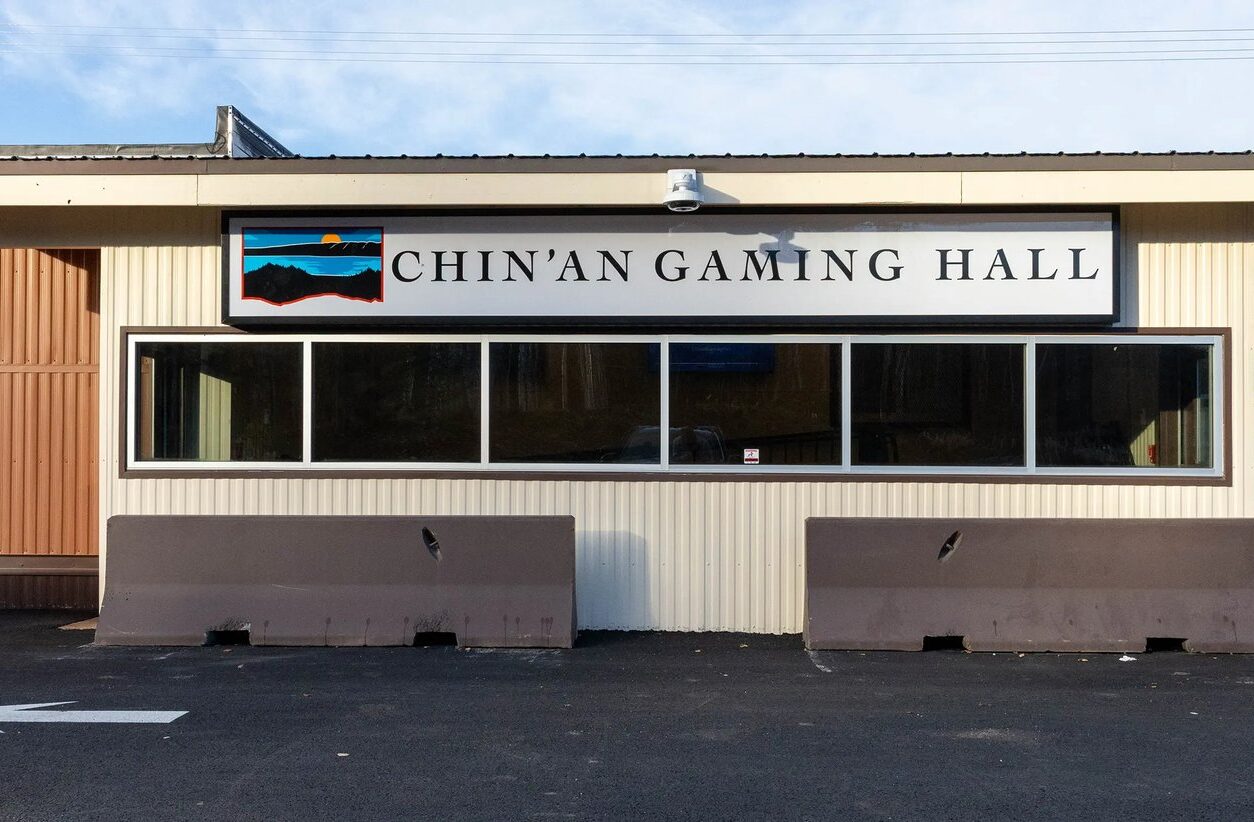

Eklutna’s Chin’an Gaming Hall is expanding. So is an old Alaska argument over Native land, business and sovereignty.
Eighty-nine gaming machines are easy to count.
So are 5,000 square feet.
Thirty-eight new jobs.
One food truck.
Those are the numbers behind the latest expansion of the Native Village of Eklutna’s Chin’an Gaming Hall, which opened near Anchorage in February 2025 and has already grown substantially.
The harder thing to count is sovereignty.
The expansion adds nearly 5,000 square feet, 89 gaming machines, a food truck and covered heated patio seating, according to Alaska Business. The hall has also added 38 employees, more than doubling its workforce.
That makes Chin’an a growing business.
It also makes it part of a much older argument.
Who gets to decide what happens on Native land?
The gaming hall operates on Native allotment land within the ancestral homeland of the Native Village of Eklutna, or Idlughet Qayeht’ana, an Eklutna Village Dena’ina people.
Chin’an describes itself as the first Class II gaming facility in Southcentral Alaska. The temporary facility fully opened to the public on February 3, 2025, and the Tribe has said it hopes eventually to construct a permanent one.
There are plenty of reasons people walk through its doors.
For the Tribe, there are also reasons the money comes back out.
The Native Village of Eklutna says revenue from economic development is intended to support housing, employment, job training, scholarships, cultural programmes, healthcare and a future Gathering Center.
That makes the gaming machines easier to understand.
They are not only machines.
They are potential paychecks.
Scholarships.
Housing.
Services.
A place for people to gather.
Native economic development is sometimes discussed as though it were simply another version of private enterprise.
For tribal nations, it can be something considerably larger.
Revenue can help pay for the ordinary machinery of self-government—staff, programmes, cultural work, youth activities, elder services and the ability to make decisions without first asking someone outside the community to fund them.
The name Chin’an means “thank you” in the Dena’ina language, according to the gaming hall.
That is worth noticing.
Because this is Dena’ina country.
The Anchorage area sits within Dena’ina Ełnena, the homeland of the Dena’ina people. Long before there was an Anchorage, Dena’ina people lived, hunted, fished, gathered and travelled across Upper Cook Inlet.
Eklutna is one of the oldest Native villages in the Anchorage area.
The casino story arrived much later.
So did Anchorage.
So did Alaska.
That longer timeline matters because contemporary disputes over Native development often begin with permits, regulations and lawsuits.
Native people frequently have to begin the story somewhere else.
With land.
The Chin’an expansion comes while the Native Village of Eklutna remains caught in a broader legal fight over tribal authority on Native allotment land.
Reporting by Alaska Public Media and KNBA said the U.S. Department of the Interior reversed an earlier federal position in 2025 concerning tribal jurisdiction over Alaska Native allotments, creating uncertainty for Eklutna’s gaming operation.
The dispute reaches into one of the stranger consequences of Alaska Native history.
Unlike much of Indian Country in the Lower 48, Alaska has relatively little reservation land. The Alaska Native Claims Settlement Act created Native corporations and transferred millions of acres into corporate ownership rather than establishing a broad reservation system.
That left Alaska tribes operating within a legal geography very different from tribes elsewhere in the country.
And sometimes very complicated.
For Eklutna, none of that is abstract.
If Chin’an continues to grow, it can create jobs, attract customers and generate revenue the Tribe can direct toward community priorities.
If federal or state policy limits the Tribe’s authority to operate it, the consequences extend beyond gaming.
They reach the larger question of whether a federally recognised Native nation can build an economy from Native land and decide for itself what happens next.
There are reasonable debates to have about gambling.
There are reasonable questions about development, regulation and community impact.
But those questions should not obscure the one underneath them.
Who gets to answer them?
The Chin’an Gaming Hall is open.
The expansion exists.
The jobs exist.
So does the legal uncertainty.
Eighty-nine new machines may be the easiest part of this story to count.
The harder measurement is how much authority a Native nation actually possesses when it begins using its own land to build its own future.
And Alaska is still working on that number.
Sources
Alaska Business — Chin’an Gaming Hall Expansion Adds Food, Games: https://www.akbizmag.com/industry/alaska-native/chinan-gaming-hall-expansion-adds-food-games/
Alaska’s News Source — Anchorage Gaming Hall on Eklutna Land Expands, While Still Facing Legal Questions: https://www.alaskasnewssource.com/2026/05/16/anchorage-gaming-hall-eklutna-land-expands-while-still-facing-legal-questions/
Native Village of Eklutna — Economic Development: https://eklutna-nsn.gov/economic-development/
Chin’an Gaming Hall — Home: https://chinancasino.com/
Native Village of Eklutna — Mission Statement: https://eklutna-nsn.gov/
Alaska Public Media / KNBA — Interior Dept. Revokes Alaska Tribal Jurisdiction Over Native Land, Threatens Eklutna Tribe Casino: https://www.knba.org/news/2025-09-30/interior-dept-revokes-alaska-tribal-jurisdiction-over-native-land-threatens-eklutna-tribe-casino
Eklutna, Inc. — Discover Eklutna and Dena’ina Heritage in Anchorage: https://www.eklutnainc.com/culture/