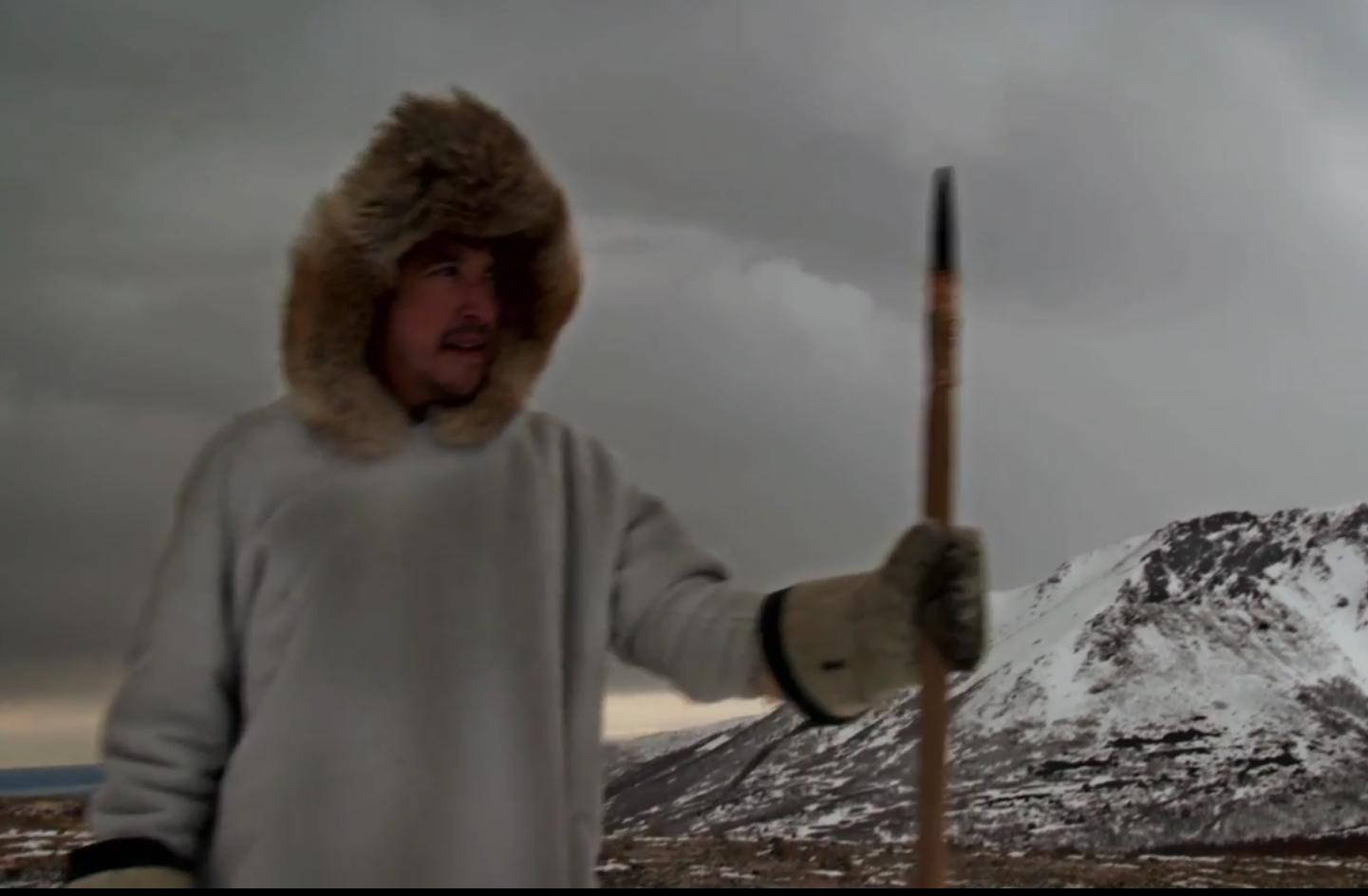

In the short film Native Time from 2009, produced by and starring the author of this article and the co-editor of The Native Times, then called Jack Dalton, an Inuit hunter following a moose somehow finds himself in a modern city, at a road intersection, with stoplights and crosswalks. While time before had been a constant, being thrust into the city, into the Western world, sent time rather askew. Standing on the corner, cars and trucks whizz past him at staggering speed. Ask any Indigenous person from somewhere rural about their experiences in larger Western communities and they will tell you something similar.
Later, we focus on the experience of a Western man who is trying to make a right turn. Simple enough, right? However, the Inuit man is trying to cross the road, and doing so very slowly. From the Western point of view, many rural people, not even just Native people, can seem to be moving slowly. Ask any Western person driving in a big city when a large Indigenous gathering is going on, and they will say something similar. Some of these drivers can get a little impatient and act… unmannerly.
When showing the film in villages around Alaska, people would come up to me and say things like, “You know what happened in there, the film, happened just like that when I went to Anchorage for AFN, the Alaska Federation of Natives, the largest Indigenous gathering in Alaska every October. I thought they were gonna run me right over! Just like that!” In fact, that was exactly where the idea for the short film came from.
Filmmaker, co-producer and director of Native Time, Sean Morris, was talking to me one day about getting a new attachment for his film camera, as in an actual film camera, for time-lapse photography. “You know,” he said, “for speeding things up and slowing things down. Now I just need an idea for some kind of short film where I can use it.”
My response was, “That sounds like Native Time.”
He hadn’t heard the concept before. “What’s that?” he asked.
I explained, “Well, Native Time is how Indigenous people experience time in a different way than Western people. Part of it is current: how living in a small, secluded village with different daily priorities will alter the way people there experience time. Meanwhile, Western people, mostly living in larger communities, have a much faster experience of time. A more extreme example would be the New York Minute. So, when these different experiences of time meet, usually in the city, people from the village experience the city as going fast, and people in the city see the villagers as moving slowly. Your time-lapse attachment could show those two experiences.”
The important thing to remember is that there would be no Native Time if Western civilisation had not become a worldwide phenomenon, paired with a great deal of technological advancement that brought every culture on earth closer together. Native Time exists only when there is a juxtaposition between two different experiences of time.
Prior to the Industrial Revolution, European time and Indigenous time experiences would have been comparable. Different time experiences then would have been more noticeable at different latitudes. Below 60 degrees latitude, there is a clear “day clock,” meaning the sun travels across the sky, sets, leading to a time of night, before the sun rises again. The lengths of these days and nights, outside of the tropics, can vary at different times of the year, but there is always a day and always a night. This means time can be measured by days.
However, beyond 60 degrees, the seasons provide a different time experience, which is really a different kind of light experience. During summer, with the earth tilted towards the sun, you get periods of 24 hours, a Western time construct, of light. Within the Arctic Circle, you can have 24-hour periods of actual sun. In other words, during summer, you can have days and days and days of nothing but days, with the sun above the horizon all of the time. Winter provides the opposite experience, with days and days and days of night. Therefore, with such seasonal light confusion, the closest thing you had to a clock was the moon, for it is visible both during the day and the night, when it is visible.
Of course, whether you have a day or a moon-th, it can also be how much you are trying, or needing, to accomplish during that time that alters one’s perception of time. People with much to do during a day, or a season, may experience faster time, whereas seasons with less to accomplish can create slower, more relaxed time experiences.
In the Western world, you still find the concept of Daylight Saving Time, though its popularity is waning. Funny enough, this has an interesting effect on livestock farms, even those run by Western people operating on Western Time. The issue isn’t with the people, who begrudgingly but successfully transition twice a year. The issue is with the livestock. You see, animals live on … Animal Time. On farms, these animals form daily habits, and when the clock changes twice a year, they don’t care at all. They want to eat when they want to eat. The farmers don’t try to train them on the new time, so the farmers, yes, White farmers, train themselves to always live on Animal Time, which is the same every day, 365 days a year.
Even more fascinating, the culture you come from, and its place in the world, can affect things like speech, with some cultures speaking much faster than others. Compare the faster languages of Spanish or Italian from the warmer southern parts of Europe with the slower, more relaxed languages of Norway and Sweden. But even then, you can have outliers to the latitude linguistic rule. The Danes, for instance, are known for speaking rather quickly, so much so that Swedes and Norwegians can have difficulty understanding them. And there are certainly tropical languages that vary in speed of talking.
Or you can get even more crazy with it. Time experience can even be seen in the pause between one person speaking and the next person speaking. In most Western languages, speaking gaps can be less than a second. In other languages, including many Indigenous languages, the normal cultural gap is much longer, up to eight seconds. Slower response time is often a sign of respect, letting the previous speaker know that you have heard them, given it thought, and are, thus, responding thoughtfully. However, this can make cross-cultural communication anything from interesting to very frustrating.
Even having grown up in the Western world, and being half White, I innately have a Yup’ik Inuit speaking protocol. This makes meetings with groups of White people complicated. Say, in an hour-long meeting with five other White people, I will be constantly trying to get a word in. But because the English-speaking gap is so short, I can’t. Even when I try to speed up my own speaking gap, it still isn’t fast enough to start speaking before someone else does. Essentially, I don’t get to say anything for most of the meeting.
Usually, however, someone will say, “Wait, we haven’t heard from James yet.”
And it’s so funny, because even when the focus is on me, I still take the longer gap. I will then make my statement. When finished, you can see the wide eyes in the room, to which someone says, “You are so wise, James. The way you made all of those connections is just amazing. It is so good having a Native person on this project. We need this wisdom.”
I, of course, find that hilarious. What I would like to say to the group is, “Don’t you guys realise? Since I couldn’t get a word in edgewise, because you talk so fast, I just spent the entire meeting listening to everything you all said. Once I heard everything, and couldn’t spend the whole time thinking about what I wanted to say, I could see the connections between what you all were saying. Nothing special at all. In fact, I believe English has a phrase for it: shut up and listen.”
Once we understand that time is actually an experience, like floating down a river, we can understand that it is far more complicated than Native Time and Western Time. We can all have very different experiences of the river. Are we in the fast part or the slow part? Are we paddling frantically to get somewhere? Or are we going with the flow, hence the river metaphor? Perhaps we are catching lots of fish as we go with the flow. Or we are desperate to get to shore to gather something or go hunting. How we experience time, and what we are trying to accomplish during that time, can have drastic effects on “our time.” And when two different experiences of time meet each other, regardless of what side we are on, we can see the difference.
So, regardless of what time you experience, Native Time, Western Time, Island Time, Indian Time, Village Time, Rural Time, City Time, Tropical Time, Cuz Time, Beach Time, Farm Time, Rez Time, whichever time, and whether you are proud of it or ashamed of it, remember that you often have little control over your perception of time, because it has been shaped by hundreds or thousands of years of time and culture and place. There is no need to judge it, or yourself. In fact, think of how you can turn the difference into a positive, as in meetings.
And, if you are curious about the short film that not only inspired this article but the name of this website, Native Time, you can find it on YouTube here: https://www.youtube.com/watch?v=TXJ-AGy6TBU
Hence, this is our promise at The Native Times: everything we do will be from a different perspective, seen through a Native, Indigenous lens. Granted, we can’t really do anything else. This means several things. We may not live up to Western journalistic standards. But who says that is the best standard to live up to? We will live up to Indigenous journalistic standards, even if that isn’t quite defined yet.
For instance, we believe in facts and “the truth,” but we also believe in not taking everything overly seriously. If you find yourself chuckling while reading a very serious article, we’ve done our job. If you read a really funny article that says something very serious, we’ve done our job.
This also means that we are incorporating journalistic standards from tribes around the globe. The way an Inuit journalist may write something could be very different from how a Zulu, or Māori, or any other Indigenous journalist writes something. We will not conform to any singular standard, but welcome all.
This also means that you, as a reader, must realise the world doesn’t necessarily see the world the same way you do. And remember, one writer doesn’t represent all of their people.
Therefore, let The Native Times not just be a tongue-in-cheek reference to a multitude of time experiences, but also a very serious representation of a multitude of journalistic experiences. You don’t have to agree with everything shared here, but we certainly hope you learn something from everything shared here.
Welcome to The Native Times.