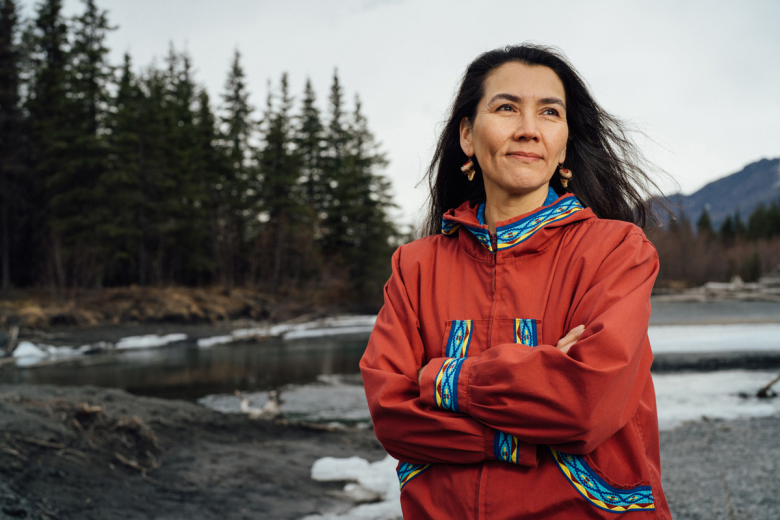
Mary Peltola Leads the Incumbent
We count history strangely in Alaska.
The United States Senate first convened in 1789. Alaska has been a state for 67 years. Alaska Native people belong to another clock entirely.
When Mary Peltola became the first Alaska Native elected to Congress in 2022, she said it mattered that Alaska finally had a representative reflecting “our 12,000-year history with this place.”
Now she is one election away from another first.
If Peltola wins in November, she would become Alaska’s first Alaska Native U.S. senator and could become one of the first Native women ever elected to the Senate. Minnesota Lt. Gov. Peggy Flanagan, a citizen of the White Earth Nation, is also on the November ballot.
History may be arriving from two directions.
For Peltola, that possibility looked considerably less theoretical after Tuesday.
The latest unofficial Alaska Division of Elections tally, posted Thursday afternoon with 400 of 403 precincts reporting, showed Peltola with 63,891, or 48.09%, ahead of Republican incumbent Dan Sullivan’s 56,756, or 42.72%.
Seven thousand one hundred thirty-five votes.
Enough to notice.
Not enough to predict November.
Alaska’s open primary sends four candidates to a ranked-choice general election, and Sullivan remains a two-term incumbent with national Republican support. The race is already drawing national attention because it could help determine control of the Senate.
Then there is the strange part.
Retired Petersburg teacher Daniel J. Sullivan Jr. survived a legal fight after Republicans accused him of running under the Sullivan name to confuse voters and help Peltola. He and Peltola denied coordination. Days before voting, Peltola also rejected an unsolicited Kamala Harris fundraising appeal, reinforcing her attempt to run as an Alaska-first Democrat rather than somebody else’s Lower 48 Democrat.
Politics being politics, November will have plenty more noise.
But one fact survived the primary:
Peltola finished ahead of the incumbent.
Now we find out whether that was a warning shot.
Or history knocking.
Before the Senate: History Happens One Event at a Time
Mary Peltola’s political story did not begin in Washington.
In began is a far-flung, rural, roadless region of Alaska.
It began with losing.
In 1996, while still in her twenties, Peltola challenged incumbent state Rep. Ivan Ivan for a Bethel-area House seat. She lost the Democratic primary by 56 votes.
Two years later, she ran again.
That time she won.
Peltola entered the Alaska House in 1999 and served for a decade, representing the Bethel region. She became part of the bipartisan Bush Caucus, where rural legislators often had to find common ground across party lines because geography, transportation, fisheries and village life rarely cared much about party platforms. Her later public service included the Bethel City Council and, from 2017 to 2022, leadership of the Kuskokwim River Inter-Tribal Fish Commission.
Fish policy in Western Alaska is rarely just fish policy.
It can mean food.
Family.
Income.
Culture.
And in Alaska, decisions made in an office hundreds of miles away eventually arrive, or not, in somebody’s freezer.
Then Don Young died.
Young had represented Alaska in the U.S. House for 49 years. His death in March 2022 opened a congressional seat that, for many Alaskans, had seemed almost permanently attached to his name.
There was also an extraordinary bit of history waiting behind it.
At the 2011 Alaska Federation of Natives Convention, Young had said, “I would be no more prouder in my life than to have an Alaska Native be the U.S. Congressman.”
Eleven years later, an Alaska Native woman took his seat.
Peltola entered the 2022 special election against a field that included former Gov. Sarah Palin and Nick Begich III, both very well-known to the electorate.
She was not the nationally famous candidate. But, vote, baby, vote.
She won anyway.
On August 31, 2022—Peltola’s 49th birthday—ranked-choice tabulation confirmed her victory. When she entered Congress, several historical lines were crossed at once.
She became the first Alaska Native person to serve in the United States Congress.
She became the first Alaska Native woman to serve in Congress.
She became the first woman to represent Alaska in the U.S. House.
And she became the first Democrat to hold Alaska’s House seat in nearly half a century.
Peltola understood what the first of those milestones meant.
After her victory, she said Alaska Natives were “not often included at the decision-making table” and described the significance of finally having a representative reflecting “our 12,000-year history with this place.”
Then she added something equally important:
“I’m more than just my ethnicity. I’m more than just my gender.”
That may be the clearest explanation of the political balancing act that has followed her ever since.
A first can change history. And history is important.
She still got only one vote. A vote worth 0.22989% of 435 votes. (Is that a lot?)
Peltola still had to do the less historic work of governing.
She served on the House Natural Resources Committee, Transportation and Infrastructure Committee, and Education and Labor Committee. She emphasized fisheries, rural Alaska and resource development while sometimes departing from national Democrats on guns, oil development, border security and other issues.
Making history was one thing.
Keeping the seat was another.
In 2024, Republican Nick Begich III defeated Peltola, ending her House tenure in January 2025.
That could have been the end of the historic chapter.
It wasn’t.
Peltola returned in 2026 to challenge Sullivan for the Senate, reviving the “Fish, Family, Freedom” political identity that helped carry her into Congress the first time. Sullivan has attacked her congressional record and sought to connect her to national Democrats; Peltola has answered by distancing herself from the Lower 48 party establishment and presenting herself as willing to fight Democrats or Republicans when she believes Alaska’s interests require it.
Now the historical scale has changed again.
The Senate first convened on March 4, 1789.
It has had plenty of time. Plenty of country. Plenty of history.
No Native woman has ever served there.
Peltola is no longer alone at that threshold. Flanagan’s Minnesota victory means two Native women could enter the Senate after November. If Peltola wins, however, one fact belongs entirely to Alaska:
No Alaska Native person has ever represented Alaska in the United States Senate.
History is not an endorsement.
It is not a prediction.
And it does not vote.
Alaskans do.
And Peltola’s career—from a 56-vote primary loss in Bethel, to ten years in Juneau, to fisheries work on the Kuskokwim, to the floor of the U.S. House, and now to a first-place Senate primary finish—has repeatedly returned to the same test.
Not whether an Alaska Native woman can reach the Senate.
Whether enough Alaskans send Peltola there.