
One of the most striking things I’ve witnessed not just in the years I worked for Cruise West, but over my entire lifetime, is the changing landscape due to the retreat of glaciers.
When I was a kid, we would often drive the 55 miles down along Turnagain Arm, south of Anchorage, to visit Portage Glacier. I loved it, I loved seeing the hauntingly blue ice, and the huge icebergs that were a fixture along the shore in front of the parking lot. I loved that even though the face of the glacier was four miles away, its immenseness, for what is really a small glacier in Alaska, was palpable. The impressions I had of Portage Glacier would inform every glacier I ever visited later in my life, whether aboard the state ferry we’d take for the adventure of it from Seward to Valdez, and stopping before the massive Columbia Glacier, with its 300 foot high termination wall, hoping beyond hope to watch skyscraper size pieces of ice calve, to the less impressive rock covered glaciers of the interior of Alaska, to every glacier we visited aboard Spirit of Oceanus, or the smaller boats I was a guest speaker on. In high school, when I could drive, I regularly, whether alone or with a friend or friends, drove to Portage Glacier just for something to do, and just to see the glacier. I was elated when the Chugach National Forest Visitor Center opened at Portage, with all of its glacier related displays and a really wonderful film that ended with a perfect shot of the glacier from the very spot the theater sat, and the screen would rise, and a curtain would part, and the exact sight would be right there, through the huge windows. It was truly awe inspiring. But then, when I started college, and took friends along on day drives to Portage, or Seward, I noticed that, as the curtain parted, Portage Glacier was shrinking more and more as the years went by. And then, one day, in the late 1990s, Portage Glacier disappeared around the corner of the mountain. As a child, I had the notion that Portage Glacier was a permanent thing, that would be there my entire life, and far beyond, because it was a glacier that had already been there for 30 or 40 or 50-thousand years. However, as climate change began to creep ever so slowly into the thick skulls of Western Civilization, I saw it happening before my eyes and to a glacier I had considered a childhood friend. Other glaciers, too, began to shrink. Columbia Glacier fell behind its terminal moraine and made a rapid retreat some 10 or 12 miles up its fjord. Exit Glacier, just outside of Seward, was shrinking similarly, as were other popular glaciers in Kenai Fjords National Park, the photographic evidence there for anyone who might be skeptical to see. Certainly, here were scientific explanations for the tidewater glaciers to be retreating, since some of them were not. Some were even growing, depending on where their terminal moraines were. These glaciers had lifecycles of their own. The effect on the landlocked glaciers was much more obvious, seen to shrink length-wise, but also markedly in thickness. Slowly, I came to the disheartening realization that these glaciers were not permanent.
When I began to work for Cruise West and Glacier Bay Cruises, every sailing that involved glaciers in some way was accompanied by stories of the slow demise of these natural wonders, and the cold hard facts, no pun intended, of the realities of climate change. Glaciers we visited regularly began to change before our eyes as we visited them year after year. Tracy Arm, with South Sawyer Glacier at its head, began retreating so quickly and casting so much ice into the fjord that we eventually could not take the ship up there anymore. My favorite place to visit along the coast was now off limits. We would steam up Endicott Arm, which was nice enough, and had its own secrets and joys, like Ford’s Terror, but it simply could not match Tracy Arm for sheer stunning and gargantuan beauty.
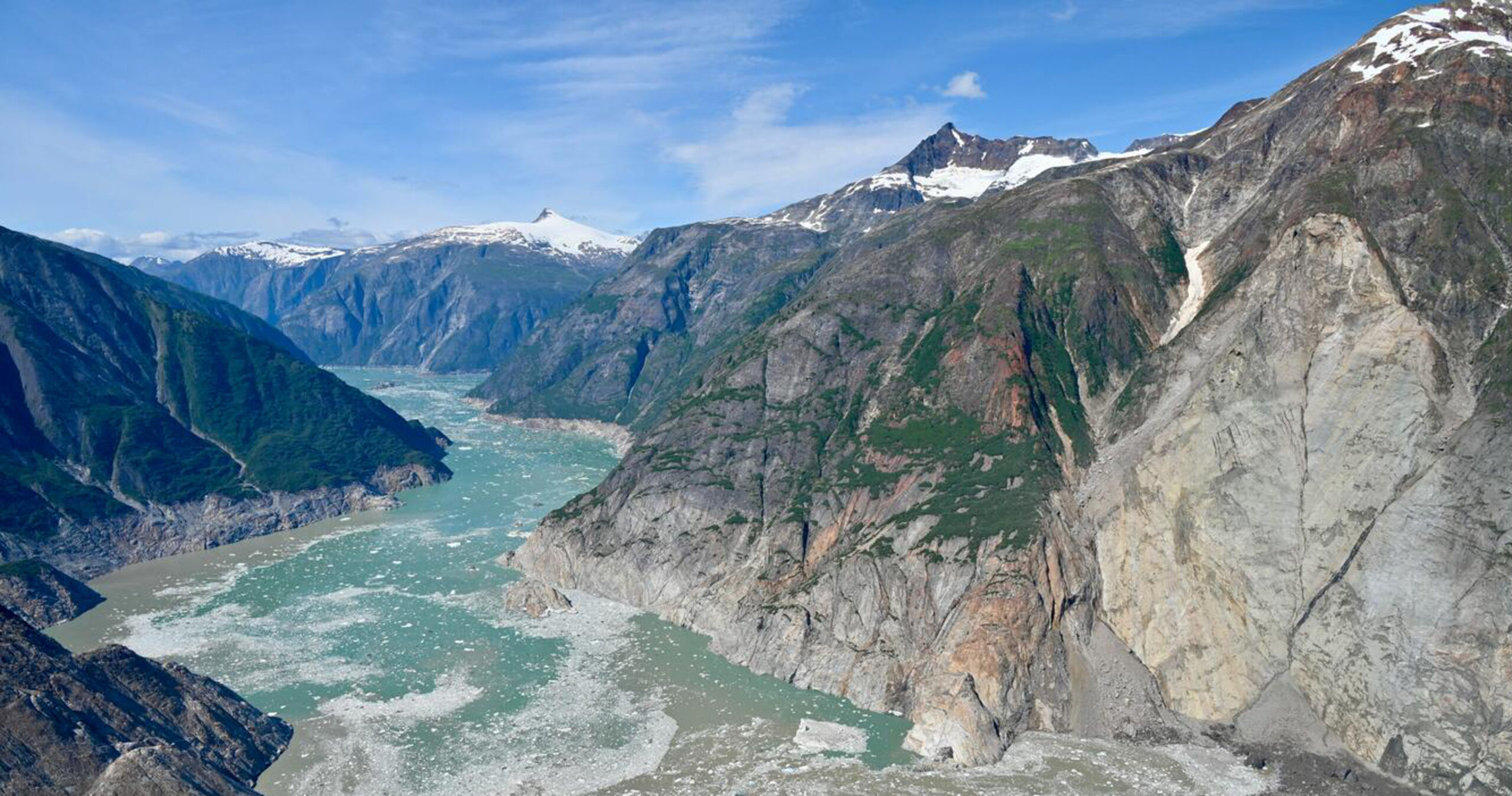
As the truth settled in about disappearing glaciers, I decided to think about the more permanent things around me. I realized how foolish it was to think of ice as something permanent in the first place, saw it as a child’s inability to understand bigger pictures. Now that I was an adult, I was able to look further afield and accept a greater reality. And so, I looked then to the mountains. Yes, the mountains. At least they were much more permanent. But then, on our first sojourn up Tracy Arm, we came around the corner of what we call the dog leg, where the incredibly hard rock of the mountains forced the glacier to make two turns of more than 90 degrees each, and on the far wall of the 3000-foot cliff was some rock that looked quite different from the rock around it. One way you can judge how recently a glacier has vacated a certain parcel of land is to look at the lichens growing on the rocks. While they may be different colors, given their various make ups, as time goes by, very dark grey lichen will bloom, darkening any kind of rock into one dismal hue, save for certain features like overhangs. This process took about 100 years to fully cover the rocks in this part of the fjord, every cliff face was the same dark grey. And yet, the wall of this particular cliff was much lighter. The, at some point, after a little bit research, we discovered that in October of 1999, a landslide had occurred, a chunk of mountain 1500 feet tall, 700 feet wide and 200 feet thick fell right of the side of the mountain into the 1200-foot deep water. The resulting wave crashed over 500 feet up the opposite side of the fjord and, if any ship or boat had been unfortunate enough to be there, would have been tossed about like a dry twig and unceremoniously destroyed. This was reported by a boat owner, a fisherman, who enjoyed toodling up the fjord now and then, often the only boat around during the winter months. He’d gone up one week, and then the next, shocked by the difference he saw and the evidence of the wave. I remember as a kid reading and account of a similar landslide occurring in Lituya Bay, some 200 miles north on the open coast of Glacier Bay National Park, in 1958, creating the highest wave ever recorded in the world, scraping the forest clean off of a mountain up to over 1500 feet. The wave raced down the bay, scouring the forest down to bedrock off the shore and from most of an island in the middle of the bay, tossing sever boats that had overnighted in a supposedly sheltered spot out into the North Pacific. That landslide had been triggered by an earthquake along the Fairweather Fault which ran across the head of the bay, shaking loose the weak rock off the glacier carved wall. While I knew such things happened, there was still an odd sense of history in which such things seemed distant because they happened before your time, or very far away. But here we were in Tracy Arm, and the gigantic scar before us was from an event that took place just a few years before. My mind was boggled.
Then the ultimate reality struck me, for my adult brain had been on earth long enough and had taken in enough Buddhism to see how impermanence went far beyond our insignificant human lives. We were sailing past the incontrovertible proof that not even mountains were permanent, that they too would crumble, tectonic plates would wander about, crashing into each other in various ways, pushing up other mountains, which would also be carved away and disintegrate, only to be built up again, and so on and so forth.
Intellectually, I already knew these things to be true. I learned about plate tectonics at an early age, fascinated by the earthquakes that rattled my town on a regular basis, and only strengthened by the eruption of Mt St Helens in 1980, and the burping of our local volcanoes on a regular basis. I gave talks on the ship about earthquakes and spoke of terranes, huge islands of rock, being carried from far off places to be smooshed onto Alaska, giving it such a varied geology, leaving geologists to dub Alaska “the garbage dump of the continents”. We would point out the places like John Hopkins Inlet in Glacier Bay where you could see four different terranes along just six miles. I most certainly knew these things to be truths. The Himalayas were just India smashing into Asia. These were facts that seemed obvious enough. But at the same time, these were things that seemed to happen so slowly, one or two inches per year (which, when you think about it, is pretty darned fast for such big chunks of our planet) over millions of years. A burp here and a shimmy there, sure, but for the most part, you could go through your life without being fully aware of the disintegration of a mountain. Then my mind extrapolates and the impermanence of the entire universe becomes startlingly clear. How lucky we are, how cursed we are, to be mere specks on a mere speck, circling a speck of a star in a speck of a galaxy, hurtling pell mell through an infinite universe. How utterly impermanent we truly are. And, yes, how lucky, as well.